Here in Spain we usually believe that Steaua was a team supported by the army of the ancient communist power. Was this true?.
Since there was no possibility for private enterprises, all sports teams were, in some way or another, governmental. Some belonged to the state institutions (Army - Steaua, Police - Dinamo, Railroad Authority - Rapid), some to educational institutions (the ones with the Universitatea/Politehnica in their names) but most of them had links with the big factories or economic conglomerates (Otelul 'Steel' Galati, Tractorul 'Tractor' Brasov etc.). This was possible after a 1946 regulation that asked all previous interbellum teams to associate themselves with a workers' syndicate of some sorts.
And then, do we have to suppose that all the players belonging to Steaua in the 70s or the 80s were, at least, friendly and faithful to the communist authorities?. I guess they just loved to play football and to get their money that way, but I´m not sure.
The footballers from that period were pretty much like the ones today: ready to drink themselves under the table, obsessed with women and lacking even the limited interest in politics. In Romania communism had two facets. First of all, there was the political construction, which interested few people. Apart from the ruling class, most of us (and I introduce myself in it as an ex-leader of my pioneer class) had no desire to follow what amounted to a lot of bullshit served on a silver platter. The second one comprised of the really bad traits that communism helped to sustain and harness: disinterest for community, working the minimum amount as not to provoke the anger of the superiors, disrespect for property etc.
The footballer were regular Romanians in this regard.
Where did Steaua got its money from?. Was a public enterprise, owned by the army or the communist party, or just a private club?.
It was an Army department and it was treated like one. But apart from the regular budget, some money came from "shady" deals. You have to understand that the footballers were officially Army employees, receiving pay as any soldier would... but most of their income relied not on this official sum but on bonuses and under-the-table understandings. You couldn't keep good players without good pay and you couldn't aim for titles or cups with a disadvantaged spending system.
Could you tell me something about Dinamo and Steaua, the rivalry, what do they represent?. Why are you supporters to Steaua and not to Dinamo?.
Theoretically the rivalry began in 1948, at the first game between those two. But in fairness the rivalry started as a conflict between two competing state institutions: the Army and the Police. There are countless sources that present the friendly relations between the players of the two teams and countless sources that picture the cold war between the heads of the two institutions. I'd say the rivalry grew as a result of the Ceausescu-Draghici dispute: in the last years of Gheorghe Gheorghiu-Dej (the first communist dictator), two of his closest men were considered heirs to his position: Nicolae Ceausescu, who had been in some capacity or other protector of the armed forces, and Alexandru Draghici, the Minister for Internal Affairs. The conflict spilled to their subordinates and football became the primary battlefield between the two armies.
The reason for being a Steaua supporter is different from one way to another. Some are Bucharest natives and so were introduced to the fan lifestyle pretty early. Some love the Army connection (since it portrays you as a patriotic individual), some are in love with the title/cup haul and most importantly proud of its European Cup. You have to understand that after 1984 (when Dinamo held superiority in the title race), Steaua won 15 titles to Dinamo's 6 (and I'm not even counting the European success). That's a pretty uneven race for any young Romanian looking for a favourite team.
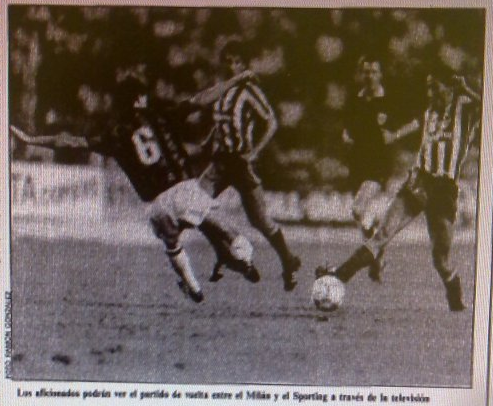
In Gijón there is only a big football club. Gijón was still that year 1991 a very industrial town, with 250,000 inhabitants, big works of steel and ship building, and a strong movement of trade unions. In another words, a working class´town with a strong socialist-democrat party in a very young democracy after a 40 years´fascist-conservative dictatorship. The day before Steaua played at El Molinón stadium, red and white players didn´t do their training as a way to give support to a general strike in the region of Asturias.
This is the difference. While theoretically the Romanian teams belonged to workers' institutions, syndicates or factories, the worker movement was just an auxillary to the state. There was no higher purpose, no socialist mentality. The players, the bosses were not there to advance the interests of the working people, just to get by and make some money.